The question I get most often about MCP is some version of: "Why would I use this instead of just calling the API directly?" It is a good question, and the honest answer is not "because MCP is newer and shinier." The honest answer is that MCP and a raw API solve different problems, and most confusion about which to use comes from treating them as interchangeable.
This post is the short version of a mental model I have been refining for six months. If you are a developer deciding whether to build an MCP server or just wire your AI application to an API, this should save you a few hours of second-guessing.
#The one-sentence difference
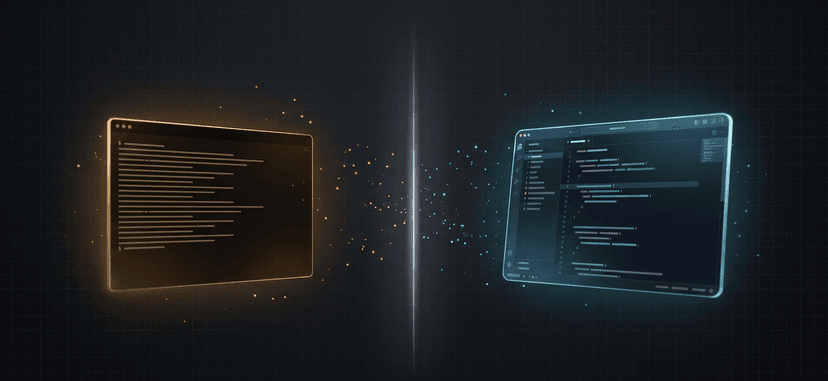
A raw API is for when your code calls the service. MCP is for when an AI agent needs to decide whether to call the service.
That is the whole thing. Every other difference is a consequence of that one distinction. If you write code that deterministically fetches data from a service every morning at 8 AM, you want a direct API call. If you write an AI agent that might need to look up a customer record mid-conversation depending on what the user asks, you want MCP.
#How an API works
A raw API is a set of endpoints exposed by a service. You write code that knows ahead of time which endpoint to hit, what parameters to send, and what to do with the response. The contract is fixed at the time you write the code.
import requests

response = requests.get(
    "https://api.linear.app/graphql",
    headers={"Authorization": f"Bearer {API_KEY}"},
    json={"query": "{ issues { nodes { id title } } }"}
)
issues = response.json()
for issue in issues["data"]["issues"]["nodes"]:
    print(issue["title"])
The developer decided when to call, what to call, and how to handle the result. The AI is not involved in any of those decisions. This is the right shape for cron jobs, webhook handlers, scheduled syncs, and basically anything where the workflow is predictable.
#How MCP works
An MCP server exposes the same kind of functionality, but it does it through a protocol that an AI client can discover at session start and then decide when to use.
from mcp.server import Server
from mcp.types import Tool, TextContent

app = Server("linear-mcp")

@app.list_tools()
async def list_tools() -> list[Tool]:
    return [
        Tool(
            name="list_issues",
            description="List open Linear issues. Use when the user asks about tickets or bugs.",
            inputSchema={
                "type": "object",
                "properties": {
                    "status": {"type": "string", "enum": ["open", "closed", "all"]}
                }
            }
        )
    ]

@app.call_tool()
async def call_tool(name: str, arguments: dict) -> list[TextContent]:
    if name == "list_issues":
        # ... actually call Linear API here ...
        return [TextContent(type="text", text="Fetched 47 open issues")]
    raise ValueError(f"Unknown tool: {name}")
The AI client connects to this server, asks "what tools do you have?", and gets back a list with descriptions. Later, when a user says "what bugs are open in Linear?", the AI model decides to call list_issues because the tool description matches the request. The server then actually makes the underlying API call to Linear.
Notice the crucial difference: the AI chose when and how to call Linear, based on the tool description. The same underlying Linear API is involved in both cases, but the division of labor is different.
#Why this distinction matters
Every time I see a team struggle with MCP versus API, it is because they did not think clearly about who is deciding what.
If you are building a chatbot that needs to answer arbitrary user questions and sometimes needs to look things up in Linear, GitHub, or Notion, you want MCP. The whole point is that you do not know ahead of time which service will be relevant. The AI decides based on the conversation, and MCP gives the AI a menu to choose from.
If you are building a nightly report that emails engineering metrics to your team lead, you want a direct API. The workflow is fixed. The AI is not in the loop. Adding MCP to this is pure overhead.
Most real systems end up with both. A nightly cron job that fetches data from several APIs directly. An AI assistant sitting next to it that uses MCP to let users ask questions about the fetched data in natural language. The two patterns do not compete, they complement.
#The decision flowchart
| Feature | Use MCP | Use direct API |
|---|---|---|
| Who decides when to call? | AI at runtime | your code, predetermined |
| Is the workflow deterministic? | no, depends on user input | yes, same every time |
| Are you building an agent? | yes | no, a pipeline |
| Do you need to react to natural language? | yes | no |
| Does the set of possible actions vary by session? | yes | no, fixed |
| Is latency critical? | moderate | important |
| Is discovery at session start acceptable? | yes | not applicable |
| Would a junior dev understand the shape? | maybe | yes |
#Three cases where most teams get it wrong
I have seen the same three mistakes enough times to generalize them.
Mistake one: building MCP for non-agentic workflows. I once watched a team build an MCP server so that their deployment script could "talk to Slack." But the deployment script was not an agent. It was a shell script that ran on a fixed trigger and always did the same thing. The MCP server added four layers of indirection to a workflow that could have been a single curl call. The right answer was a webhook, not an MCP server.
The tell: you are building an MCP server but there is no AI model in the loop making decisions. If a human or a script always decides when to call the server, you do not need MCP, you need a function.
Mistake two: treating MCP as a drop-in replacement for internal APIs. Another team I know tried to migrate their internal microservices to MCP servers because "everything should be MCP now." Their microservices were called by other microservices on a predictable schedule. The migration added latency, complicated deployment, and did not give them any new capabilities. They rolled it back after a month.
The tell: the services being called are not called by AI. They are called by other services in a fixed architecture. MCP is the wrong layer to sit between two pieces of deterministic code.
Mistake three: skipping MCP when you do actually have an AI deciding what to call. The opposite mistake is also common. A team builds an AI assistant that has custom logic for calling three different APIs, hard-codes when each one gets called, and ends up with a brittle if-else tree the AI cannot reason about. Then they find out that every new API they add means more custom code, and the AI cannot use new tools without a code deploy.
The tell: you have an AI in the loop but you are making decisions on its behalf instead of letting it choose. Every hard-coded "if user asks about X, call Y" in your codebase is a place where an MCP server description would have let the AI decide dynamically.
#What about latency and overhead?
MCP adds a small amount of latency. The client-server handshake, the tool discovery at session start, the JSON-RPC message overhead. In practice, this is negligible for anything longer than milliseconds. If your workflow cares about microsecond-level latency, MCP is the wrong layer, and honestly your AI workflow is probably also the wrong layer.
The more real overhead is operational. Running an MCP server means you have one more process to deploy, monitor, and keep updated. For a small team, this is a real cost. The tradeoff is worth it if you have multiple AI clients (Claude Code, Cursor, ChatGPT, internal tools) that all need to integrate with the same services. Build the MCP server once, plug it into every client, done.
#When to build your own MCP server
Short version: only when there is no existing server that does what you need.
As of April 2026, the official MCP server directory and PulseMCP list more than 10,000 servers. The common ones (filesystem, GitHub, Slack, Notion, Linear, Stripe, SQLite, Postgres) already exist and are maintained by either Anthropic's reference team or the vendors themselves. Building your own for something that already has an official server is usually wasted effort.
When you should build your own:
- You have an internal API that does not exist in the public MCP ecosystem
- You need tighter security or scoping than the public server offers
- The public server is slow, broken, or unmaintained
- You need custom resources or prompts that the public server does not expose
If none of those apply, install the existing server and move on.
#Does MCP replace APIs?
No, and this question comes up enough that I want to end on it specifically. MCP does not replace APIs. MCP sits on top of APIs. Every MCP server I have mentioned in this post calls an underlying API under the hood. The MCP layer is an adapter that makes the API callable by an AI model, not a replacement for the API itself.
The right mental model: MCP is how AI agents talk to APIs. APIs are how services talk to each other. These are different layers, they do not compete, and every serious AI system uses both.
Try It Out
Getting ready for AI-tooling interviews?
MCP versus API is becoming a common question in engineering interviews. Our AI interview prep covers the architectural decisions employers actually ask about.
#FAQ
Frequently asked questions
What is the difference between MCP and an API?
Does MCP replace REST APIs?
When should I use MCP instead of calling an API directly?
Can I use both MCP and direct APIs in the same system?
Is MCP slower than calling an API directly?
Do I need to build my own MCP server?
#Related reading
- What Are MCP Servers? is the pillar guide to the MCP ecosystem
- Claude Code: The Complete 2026 Guide for how MCP fits into Claude Code specifically